 Topeka Egress Windows
 Window Well Installation and Replacement in Topeka
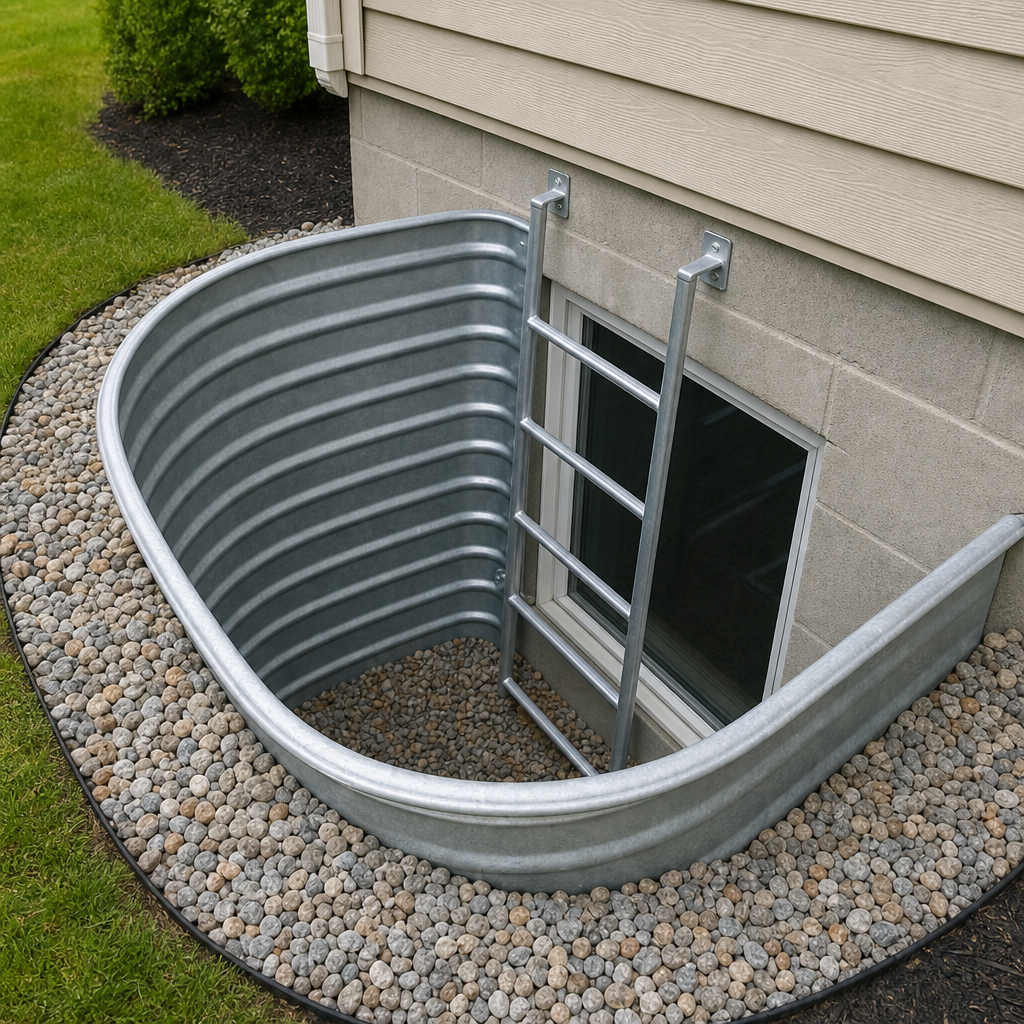
A window well installation in Topeka puts a code-sized, anchored, drained well around a basement window: at least 9 square feet of horizontal area and 36 inches of projection under R310.4.1 of the 2021 IRC, a permanently attached ladder when the well is deeper than 44 inches under R310.4.2, and a gravel drainage bed underneath so the well does not fill in the first May storm. A well replacement on an existing opening runs $1,000 to $3,000 installed; on a new egress cut, the well is included in the full-install price.
The well is not the accessory. On Shawnee County clay, it is half the job.
What the code requires of the well
Topeka adopted the 2021 International Residential Code (Ordinance 20467, December 2023) without amending Section R310, so the well rules are the model code’s:
- Horizontal area of at least 9 square feet with a minimum width and projection of 36 inches (R310.4.1). The 36-inch projection is the number most old wells miss; the corrugated half-rounds on 1960s ranches stick out 18 to 24 inches.
- The ladder or steps may encroach up to 6 inches into those dimensions (the exception to R310.4.1).
- Wells deeper than 44 inches need a permanently affixed ladder or steps with rungs at least 12 inches wide, projecting at least 3 inches from the wall, spaced no more than 18 inches on center, for the full height of the well (R310.4.2). These ladders are exempt from the stair rules in R311.7.
- Any cover has to be releasable or removable from inside without keys, tools, or extra force (R310.5). Covers are their own page: well covers and drainage.
A well that is sized to the window but not to the code is the most common thing that gets replaced.
Why wells fail in Topeka
Rust. Galvanized corrugated steel was the standard well from the 1950s through the 1980s, and it lasts 15 to 25 years in wet clay. The rusted-through half-rounds on Highland Park and west-side ranches are the volume business here.
Undersized. Wells installed for light and ventilation were never meant to be egress wells. Eighteen inches of projection was fine for a hopper window. It is not an exit.
Never drained. This is the big one. The USDA soil survey of Shawnee County maps the uplands in loess and glacial till soils. The Pawnee series (till) carries 37 to 48 percent clay in the subsoil, low saturated hydraulic conductivity, and a perched water table from February through April. The Wymore series (loess) runs 42 to 55 percent clay with high linear extensibility, which is the soil scientist’s way of saying it swells wet and shrinks dry. Water that gets into a well dug in that material does not soak away. It sits.
Spring rain. NOAA’s 1991 to 2020 normals for Topeka: April 3.81 inches, May 5.17, June 4.92. That is 13.9 inches, 38 percent of the year’s precipitation, in the three months the ground is already saturated. An undrained well fills, freezes and thaws through March, and pushes against the foundation all spring.
Pulled away from the wall. Wells that were never anchored, or were anchored into crumbling block, tilt outward as the clay heaves, opening a gap that pours water straight down the foundation.
How a well goes in
1. Remove and excavate. The old well comes out. The dig goes to the new well’s depth plus room for the drainage bed, and wider than the well so the backfill can be gravel rather than the clay that came out.
2. Drainage first. A gravel bed below the sill, and below frost where the dig allows. If the house has footing drain tile that still flows, the well drain ties into it. If the original clay tile is silted shut, common in 1950s and 60s houses, a deep gravel dry well beside the well does the job instead. You should know which before you sign.
3. Set and anchor. The well is anchored to the foundation with masonry fasteners through its flanges, sealed at the wall so water cannot run behind it. Composite and modular stone-look wells assemble in courses; corrugated steel goes on in one piece.
4. Ladder. If the well is deeper than 44 inches, a ladder or steps goes in, rungs 12 inches wide, 3 inches off the wall, 18 inches on center, per R310.4.2.
5. Backfill and grade. Gravel around the well, soil above, graded to slope away from the house so surface water does not run into the well in the first place.
6. Cover, optional. Polycarbonate or grate, $150 to $600, opening from inside without tools.
Materials and what they cost
| Well material | Typical installed | Life | Notes |
|---|---|---|---|
| Galvanized corrugated steel | $1,000 to $1,600 | 15 to 25 years | The budget choice, still fine with proper drainage |
| Composite (one-piece) | $1,600 to $2,400 | Decades, no rust | The usual pick on a visible wall |
| Modular stone-look | $2,200 to $3,000 | Decades | Terraced, planted, the premium look |
All three meet code when sized right. The spread is life and looks, not compliance.
Wells on new egress openings
On a full egress window installation the well, ladder, and drainage are part of the $3,500 to $6,500 price, sized to the new opening from the start. The well is also where a deep dig shows up in the quote: a full-depth basement with high grade means a well past 44 inches, which means a ladder and more excavation. That is the honest reason two similar houses get different numbers, and the pricing page shows it line by line.
Service area and permits
Topeka and Shawnee County, plus Lawrence, Holton, Auburn, Rossville, and Osage City. Whether a stand-alone well replacement needs a permit varies by office, so check before anyone digs; a well on a new opening rides on the egress permit. Request a free on-site measure, and if your well fills every spring, mention it, because the fix is usually drainage rather than a new well.
Frequently Asked Questions
How much does a window well replacement cost in Topeka?
$1,000 to $3,000 for a well on an existing opening, including removal of the old well, excavation, a new code-sized well anchored to the foundation, a ladder if the well is deeper than 44 inches, a gravel drainage bed, and backfill. Galvanized steel sits at the low end; composite and stone-look modular wells at the high end.
What size does a Topeka window well have to be?
Under R310.4.1 of the 2021 IRC, which Topeka enforces, a well serving an egress window needs a horizontal area of at least 9 square feet and a width and projection of at least 36 inches. The ladder may encroach up to 6 inches into those dimensions. If the well is deeper than 44 inches, R310.4.2 requires a permanently attached ladder or steps.
Why does my old well fill with water every spring?
Because it was set in clay with no drainage under it. Shawnee County's upland soils, the Pawnee and Wymore series in the USDA survey, run 37 to 55 percent clay in the subsoil and hold a perched water table in spring, and NOAA normals put over 10 inches of rain on Topeka in May and June combined. A well without a gravel bed tied to drain tile or a dry well is a bucket.
Does a well replacement need a permit?
Replacing a well on an existing opening is usually treated differently from cutting a new one, but the rules vary between Topeka, Shawnee County, and the surrounding towns, so we confirm with the specific office before digging. If the well is part of a new egress opening, the permit covers it.